

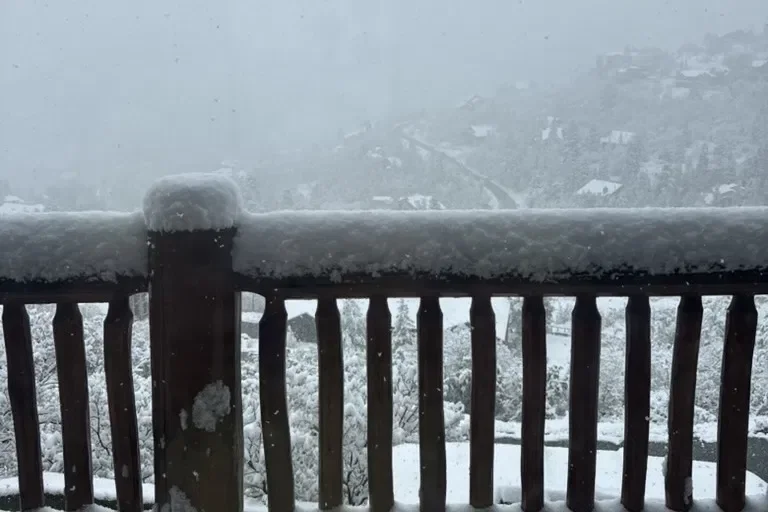
The view from my window as I write
Today, as I sit here with my Great Dane a hundred-pound weighted blanket on my feet and soft, slushy snow falling outside the window, I feel the arbitrary slowing of time. I am not a slow or patient person, partly a result of my millennial Type A upbringing partially a reflection of my innate, fiery pitta personality. I hate waiting. And I’ve been doing a lot of waiting recently. Waiting for the herbs to kick in and help my body bounce back from this cold, waiting for my energy levels to pick back up, waiting until it’s time for me to be able to go to bed already tonight: waiting, waiting and more waiting.
Today, though, as I sip my cinnamon and clove tea, this feeling creeps up on me; I don’t know where it came from because, ahem, not in my nature, but it was this stolen moment of feeling like I was given a gift. A pause. A space between breaths. Time to reconsider, reframe. I had the house to myself, blissfully rare and quiet- even the dogs refrained from barking. In delicious slippery seconds, I watched tender, soft snowflakes drift gently down and land, embracing each other on the wooden windowsill. I had no clients today and nowhere to be for several hours yet. In this seemingly stolen moment, I asked myself: What do I want? What do I need?
And I gave myself the gift of listening. I put together a Lego wildflower kit, a new audiobook playing in the background. I lounged in bed with my two dogs, enjoying a yoga nidra. I called a friend. Yes, I am still very much waiting for the cold to go away, to feel fully better. But I stopped trying to fix it. I let it be and leaned into the stillness it gave me. (Okay, maybe not as still as I could have been, but quiet in body and mind at least!) Still waiting… but there can be life in the waiting too.
As we gear up to dance into the gatherings with friends and family this month, I invite you to breathe into the pauses when you can. The tempo will invariably increase as we swirl through recitals, performances, and kids’ concerts, the volume of holiday cheer eddying up, up and up until we crescendo through the New Year. Yet, I encourage you to soften and savor. May you have quiet, unexpected moments to watch the snow fall, to hold a warm cup of tea, and to marvel in the gifts of the ordinary everyday. May there be gratitude and appreciation for the slowness alongside the hustle and bustle; instead of rushing to the next party, the next gathering, may you instead pause to breathe and soak it in. Try to catch that snowflake on your tongue or, better yet, make yourself a snow angel just because you can!
☾ Research Reflections
With gratitude November’s evergreen buzzword, it seemed fitting to dig a bit into how it can (or can’t) impact our well-being. While the positive psychology zeitgeist would have you whisper a nightly list of what you’re thankful for, does it matter or do good beyond a temporary shift in your emotional state? In 2020, a group of scientists reviewed more than 1,400 peer-reviewed publications to determine how gratitude interventions impacted objective and subjective measures of one’s health. They analyzed data from the 19 most rigorous articles, wherein participants were randomly assigned to either a gratitude intervention or a control condition. For at least one week, they had to spend time writing or thinking about what they were grateful for (gratitude intervention) or complete an alternative activity of similar length (control condition [e.g., mindfulness meditation or listing all the things they did that day]). Data from these studies revealed a few key findings:
Participants practicing gratitude had significantly lower blood pressure and better blood sugar response. Some individuals also had improvements in inflammatory blood markers. However, no significant changes in cortisol (stress hormone) levels or heart rate variability (a measurement of heart health) were associated with gratitude interventions.
On subjective markers, some participants engaging in gratitude interventions reported they felt better physically, slept better, and had fewer asthma-related symptoms. Self-reported pain levels remained the same, regardless of whether participants were in the control or gratitude conditions.
The “dose” of gratitude intervention seemed to matter; the more frequently participants practiced gratitude, the more pronounced the effect seemed to be on their physical well-being. Participants who cultivated gratitude at least 3-5x per week showed more positive health outcomes than those who engaged in gratitude interventions only once a week.
This research by Boggiss et al. (2020) demonstrates initial evidence that raising one’s vibration to the level of gratitude has very real physiological impacts. And we owe it to ourselves to practice these techniques more often than just once a year around the Thanksgiving table. I would love to see future research explore how gratitude interventions impact our central nervous system response and whether they can help us more quickly shift from “fight or flight” to a “rest and digest” response; this seems particularly relevant for those of us who have suffered from traumatic events and are working to retrain our nervous systems to see more good in the world!
Source: Boggiss, A.L., Consedine, N.S., Brenton-Peters, J.M., Hofman, P.L., & Serlachius, A.S. 2020. A systematic review of gratitude interventions: Effects on physical health and health behaviors. Journal of Psychosomatic Research. 135. https://doi.org/10.1016/j.jpsychores.2020.110165
Have a suggestion or question you want to see addressed in the Research Reflections? Send me an email at bri@moonflowerparkcity.com and I’d be happy to cover it in the next Notes by Moonlight.
☾ In Season
Vata, the dosha comprised of air and ether, reigns over fall. We have only to think about brisk autumn days, with the wind whipping leaves into a swirling, curling spiral to know it. Its there in the crunch under our feet as we walk under bare trees or the sharp lick of cold on your fingertips. Embodied, vata feels cold, light, dry and mobile. To balance it within ourselves, we can welcome in more food and practices with warming, heavy, and moist qualities.
One of my favorite vata-supportive rituals in fall is a nightly oil-based foot rub (abhyanga), just before bed. I warm about 1 tsp of sesame oil (microwave or in a massage oil heater) and slather some on the sole of one foot, doing one at a time. In gentle circles, I rub and massage it on the bottom of my foot; I like to give extra time to the more tender areas, like my arches. Make sure to rub 5-7 circles as well around your heels, letting the oil soak into the place where sole and lower ankle meet (which also tends to crack under vata’s dry conditions). Add more oil as needed, working your way up the foot again to each toe. I like to personally thank each part of my foot as I massage, sending it love and gratitude for all it does to keep me moving through the world. I spend time rubbing oil between the toes and pressing lightly on the pressure points there for a few seconds, before oiling the top of my foot. I usually end around the ankle, rubbing around the ankle bone itself 5-7 times. If you choose and it’s right for your vikriti (current state of well-being), you can seal in the oil by placing a cozy sock over your foot. It’s recommended that you leave the oil on for at least 30 minutes before rinsing it carefully off in the shower or sink. When called, I also rub some of the warm sesame oil behind my ears and massage it into the earlobes themselves. The Ashtanga Hridayam, a classical Ayurvedic text, calls out the head, ears and feet as especially important places for self-oil massage; they are where vata collects most easily and thus benefit the most from a vata-reducing practice. Of note, abhyanga is not traditionally recommended during an acute illness or when menstruating.
☾ Offerings
I’m happy to share that gift certificates are finally live on my website! I now offer six moon-phase certificates in set amounts (yes, I’m a sucker for a good theme), that range in price from $44.40 to $275. Each one can be used for any session or training, and never expire. They arrive by email and can be printed, so they work for last-minute gifts too.
☾ Rising Soon
My first Reiki I training is coming up January 9-10, 2027. No experience is needed to join; if you have ever felt called or curious about energy healing, this introduction to Reiki will provide hands-on opportunities to dabble and play. You’ll receive an attunement (allowing you to channel Reiki energy from Source), learn how to give Reiki to yourself and others, and practice in small groups. Spaces are limited to six individuals, and a gift certificate can be used toward the training.
Have questions? I’m always happy to answer them and here to help! You can text me at 435-268-1892.
Until next month, may you find a little life in the waiting.
With gratitude & may you dance on moonbeams,
Bri
